
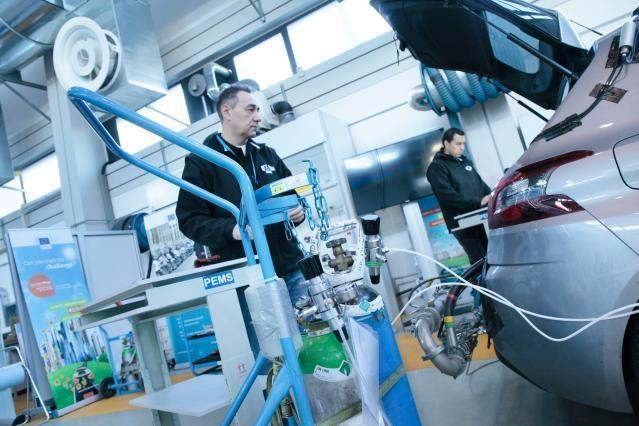
The Ispra (Italy)-based Vehicle Emissions Laboratories (VELA) comprises two well-equipped chemical and physical analysis labs and ten major testing facilities capable of conducting emissions tests (including the measurement of evaporative emissions) on a variety of vehicles.
These range from motorbikes to passenger cars and even large heavy-duty engines. Findings made at these facilities have provided scientific support for the development of new EU Directives and the revision of older ones, as well as for the assessment of new measurement techniques and procedures. They have also provided answers to other scientific challenges, such as the toxicity of emissions from motorcycles.
Take a virtual tour through the lab!
Statements for Accreditation and Independence/Impartiality of Testing and Inspection Activities
- Accreditation
Vehicle Emissions LAboratory (VELA) is an independent and impartial research facility with the following Accreditation Certificates:
- ISO/IEC 17020 Accredited Inspection Body, accreditation Accredia No 0480ISP for
In-Service Conformity compliance checking on light duty vehicles;
- ISO/IEC 17025 Accredited Test Laboratory, accreditation Accredia No 1911L for both:
- Worldwide Harmonised Light Vehicle Test Procedure (WLTP);
- Real Drive Emission (RDE) performed as on road tests.
VELA acts as an independent Inspection Body internally to the European Commission.
The Accreditation Agreement due for Inspection Body and Test Laboratory is available at this link.
The functional e-mail for contacting VELA is: jrc-c04-sec@ec.europa.eu.
- Impartiality, Independence and Integrity
In all the performed activities, JRC VELA acts in line with the:
JRC Integrated Management System Policy IMS-JRC-4.1-POL-0001 (Internal Reference: Ares(2020)6802786 - 16/11/2020), which states JRC Management commitment to:
- ensure that the vision, mission and core values of the JRC are communicated, understood, implemented and maintained at all levels of the organisation;
- meet customer needs with sound and impartial scientific support and advice;
- enhance customer satisfaction by ensuring that products and/or service requirements are properly identified, monitored and addressed along the entire Work Programme design and implementation processes;
- operate in order to ensure that risks and opportunities related to the products and services are determined and addressed;
- ensure that processes are described and executed in a systematic manner, and that process performance is monitored by means of appropriate objectives and indicators;
- increase the effectiveness and efficiency of the organisation by continuously improving the JRC Integrated Management System and its processes;
- comply with all legal and statutory requirements as well as with any management standards policies implemented.
The JRC Complaint and Appeal procedure is available upon request at the functional e-mail address: JRC-C04-SEC@ec.europa.eu
JRC Scientific Integrity Statement (2015) (Internal Reference: Ares(2015)2830147 - 06/07/2015):
“The reputation of the JRC as the Science and Knowledge Service of the European Commission is built on the quality of its research and on the intellectual rigour with which it prepares and presents scientific evidence. Independence, objectivity and transparency are crucial for the trustworthiness of the JRC’s research work. Proper conduct of research requires high standards of integrity based upon principles and professional responsibilities among staff.”
The JRC leading principles are:
- Excellence and honesty in our research
- Objectivity in our positions
- Accountability in the conduct of research
- Independence and impartiality in all aspects of our research
- Cooperation in working with others
Impartiality and Transparency of the Inspection Body
The Inspection Body, in the scope of accredited testing (ISO/IEC 17025) and inspection activities (ISO/IEC 17020), is committed to the following:
- not being involved in design, manufacture, supply, installation, use or maintenance activities related to the vehicles under research, inspection and testing;
- systematic and documented controls aimed to mitigate possible conflicts of interest of the employees involved in every single testing and inspection activity;
- systematic risk analysis on Impartiality, Integrity and Independence, documented at Unit level;
- not being involved in test/inspection activities without an clearly defining the activities to be performed.
For Impartiality purposes, inspection services are only provided to European Commission Directorates, under contractual forms or Administrative Agreements. No private customers are allowed to ask for accredited inspections or tests.
Upon request, the exhaustive Policy on Integrity, Impartiality and Independence is made available to customers internal to the European Commission.
Regulatory commitment
- To communicate accredited test/inspection results in the official EU Electronic Platform as defined in the In-Service Conformity process (Regulation (EU) 2017/1151)
- To make available information on activities performed, according to Regulation (EC) No 1049/2001 regarding public access to European Parliament, Council and Commission documents
- To make available upon request JRC-C04-SEC@ec.europa.eu public information related to the activities performed
Related Content
Portable Emissions Measurement Systems (PEMS)
EC-AV Portal - Vehicle Emissions Laboratories, 2019
European market surveillance of motor vehicles report
Related Documents
Vehicle Market Surveillance factsheet