
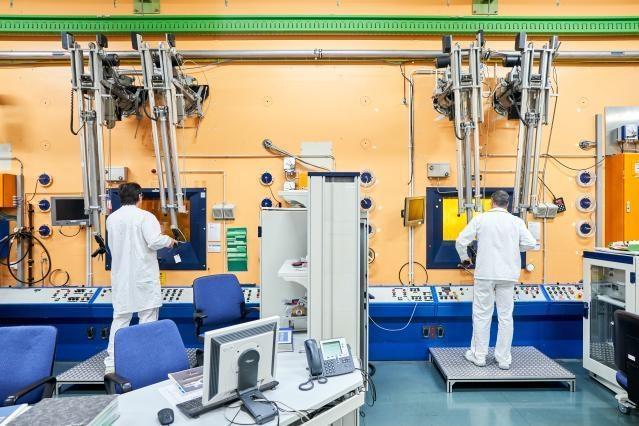
The hot cell laboratory consists of 24 shielded hot cells where highly radioactive materials (including full length light water reactor pins) can be received, handled, examined and returned to their owners.
It also incorporates a suite of decontamination cells and cabins, supporting the hot cell operations, as well as a number of internal transfer vessels, enabling sample movement within the building. Many cells are fitted with an alpha tight stainless steel containment, which enables their operation under protective gas environment.
The ultimate goal is to maintain and develop this unique infrastructure as an open access facility serving Europe. In addition, the hot cells are essential for the implementation of the Directorate G’s programmes on nuclear safety, waste management and decommissioning.
Facility
The facilities today are equipped for Post Irradiation Examination (PIE) of nuclear fuels, including non-destructive visual inspection, profilometry, gamma scanning, etc. Fission gas release determination via puncturing is performed. Destructive examination centres on polishing and optical/ electron microscopy and microprobe examination of the fuel microstructure. High temperature treatment of small fuel samples is achievable. Hydrogen determination in the cladding is also realised. The facility serves as a hub for the preparation of spent fuel samples for Knudsen effusion mass spectrometry and thermal diffusivity measurements, etc.
The facility is supported by two dedicated decontamination cells as well as a decontamination cabin. Furthermore, mechanical workshops, one specialised in manipulator maintenance, provide the essential technical support for the laboratory and its concomitant R&D programmes.
Mechanical properties of 250-300 mm pre-pressurised fuel rod sections using three point bending and impact device are determined to answer emerging issues pertaining to interim fuel storage and subsequent handling. This domain will shortly be strengthened by the addition of small punch and ring compression testing capabilities.
A suite of chemical cells enables investigation of the back end of the fuel cycle, where the focus is currently on the stability of irradiated fuel in ground water, under both oxidising and highly reducing conditions expected in the final geological repositories. The stability of damaged fuel (“corium”) in fresh, borated and sea water is also investigated. Separate effect studies on deliberately prepared samples with alpha emitters or simulated fission products are performed in standard gloveboxes.
A dedicated analytical sector provides ICP MS measurements of leachates as well as full characterisation of dissolved fuel samples, including burn-up determination. Furthermore, analytical methods for the determination of key ß emitters at trace levels by high resolution ICP-MS coupled to automated flow injection techniques are developed for so called “difficult to measure nuclides”, and are augmented by alternative innovative initiatives based on laser spectroscopy (14C, 36Cl, etc.). Dedicated radiometric measurement tools are also available.
Currently, several investments are ongoing to upgrade and modernise the Hot Cells and the associated analytical tools therein, to generate knowledge beyond the traditional “quasi engineering scale approaches” hitherto pursued. A Raman spectrometer for the determination of surface composition is now being installed in a hot cell. In a parallel laboratory, a FIB is being commissioned. The Hot Cells themselves will host a new state of the art SEM equipped with EBSD to determine grain orientations prior to aqueous stability testing, for which a new facility to handle miniaturised (mm3) spent fuel samples, furnished with on line gamma and gas analysis, is being commissioned. In the same vein, the potential of electrochemical microscopy and Kelvin probe methods are being evaluated for incorporation in this facility. A dedicated XRD station for spent fuel discs has been delivered and will be installed shortly. New mechanical testing devices (high temperature testing bench and nano indentation) are also foreseen.
Activities
See each activity below a a list of methods;
Post Irradiation Examination of Nuclear Fuel
NDT, puncturing, X-ray radiography
Microscopes: light, SEM, TEM etc
EPMA, SIMS, laser ablation ICP-MS for elemental analysis
Annealing furnaces (1500-2500 °C) in various atmospheres
Special annealing furnace (KÜFA) for coated gas cooled reactor fuel
µ x-ray diffraction
High temperature µ-indentor
Acoustic probe for porosity measurement
µ-gamma scanning
hydrogen determination in irradiated cladding by hot inert gas extraction
Burst and creep testing furnaces
High Resolution ICP-MS
radiometric techniques including alpha- and gamma spectrometry and liquid scintillation counting
Revaporisation facility for aerosol deposit analysis
Spent Fuel Characterization in View of Long Term Intermediate and Final Storage
Electrochemical cells to study the corrosion behaviour partly combined with surface analytical techniques such as XPS
Special techniques (e.g. electrochemical noise) used to detect extremely slow corrosion
Quartz micro-balance to measure corrosion rates in the sub-ng range
Flow-through reactors to study the leaching behaviour under dynamic conditions with on-line Eh measurement
ICPMS, radiometric techniques (alpha-, gamma-spectroscopy, liquid scintillation counting) for chemical analysis
Oxidation furnaces to determine the fuel oxidation
X-ray for intermediate oxidation testing
Reprocessing & Separation of actinides from irradiated fuels and targets
Centrifugal contactor battery for continuous counter-current extraction
Hollow fiber module to optimise extraction efficiency
titration equipment for acidity determination
Chemical Analysis: ICP MS radiometric techniques etc.
Hot cell for pyroreprocessing under pure Ar atmosphere equipped with:
- electrorefiner
- molten salt
- molten metal extractors
- chlorination device
Double glove box to study basic thermodynamic data of actinides in molten salts
Glove box to study the conversion of oxide fuel into metals
Glove box to study room temperature ionic liquids
Mechanical workshops, specialized in manipulator maintenance, provide the necessary technical support for the laboratory.
A large variety of techniques are available for various research programmes with the Hot Cell Laboratory.
Laboratory photos
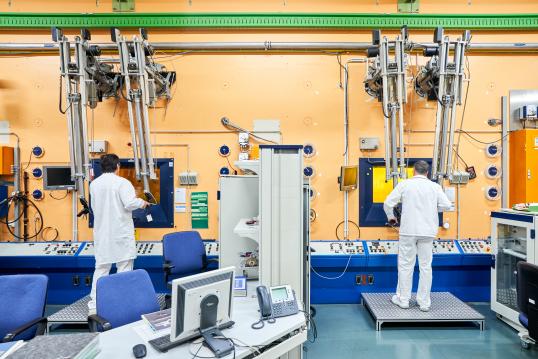
The Hot Cells facility has 17 shielded hot cells, including 2 decontamination cells. © European Union, 2021
You can view additional images of the Hot Cell laboratory at the JRC Digital Media Hub.