
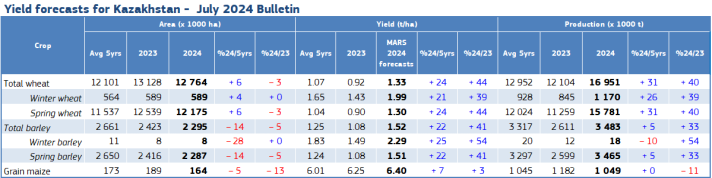
So far, wet, cold and hot spells had limited impact on positive yield outlook for winter and spring cereals
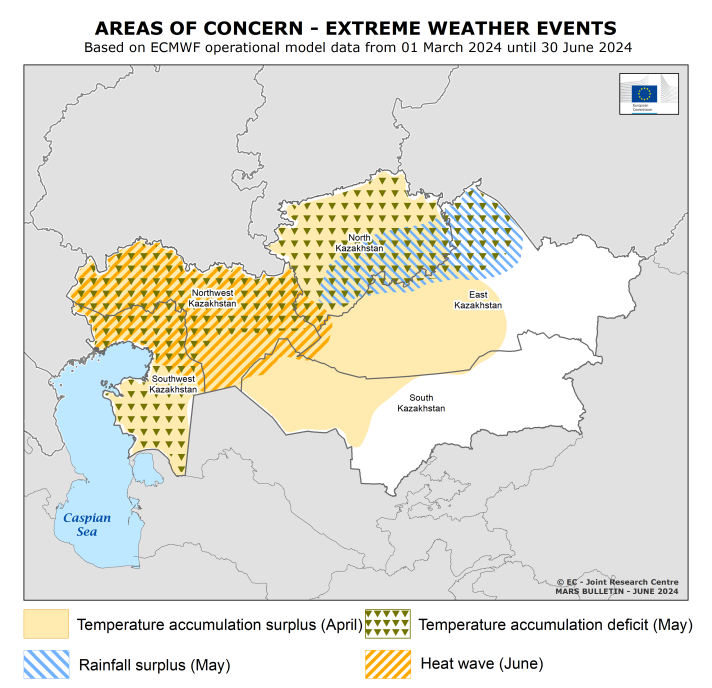
Mild April conditions allowed an early start to the sowing campaign of spring wheat and spring barley, which – in terms of area and production - are the most important crops in Kazakhstan.
In May, colder-than-usual conditions and above-average precipitation in the northern half and eastern regions of the country delayed progress on sowing and the emergence and initial development of spring cereals. Subsequent warmer conditions allowed growth and development of spring crops to catch up in the North Kazakhstan macroregion (Akmolinskaya, Kustanayskaya and Severo-Kazachstanskaya), and the above-average soil moisture levels promise sustained growth during the coming flowering period. However, the situation remains delicate, because adequate water supply and mild temperatures will be needed during the grain-filling period to realise the currently very high yield potential. A heatwave in June adversely affected the yield formation of winter wheat in the north-west, which is of less importance at country level.
In South Kazakhstan, the spring sowing campaign progressed well; winter and spring cereals present advanced phenological development and above-average biomass accumulation, thus raising expectations of high yields.
Grain maize outlook in line with historical trend
Grain maize is mostly cultivated in southern Kazakhstan under irrigated conditions. Therefore, interannual variation in yields tends to be relatively small. The grain maize yield forecast is above average and follows the historical trend.
Further information
Subscribe to the JRC MARS Bulletin | (Unsubscribe from your profile page)
JRC MARS (Monitoring Agricultural Resources) Bulletins
The latest information about global agricultural production hotspots for countries at risk of food insecurity is available on the JRC’s ASAP (Anomaly hot Spots of Agricultural Production).
Details
- Publication date
- 8 July 2024
- Author
- Joint Research Centre
- JRC portfolios


